Pet Care
Latin America's Pet Shelves Are Going Own-Brand
Brazil's biggest pet retailers grow fastest on own-brand. What a private-label grooming program needs: formulas, files and stable supply — and how to start one.
Latin America's largest pet retailers are growing fastest on their own brands. For a retailer, an own-brand grooming line is now a profit decision, not a branding exercise. This guide explains what the line needs — formulas, documentation and stable supply — and how to start one with an OEM.
What just happened in Brazil's pet retail?
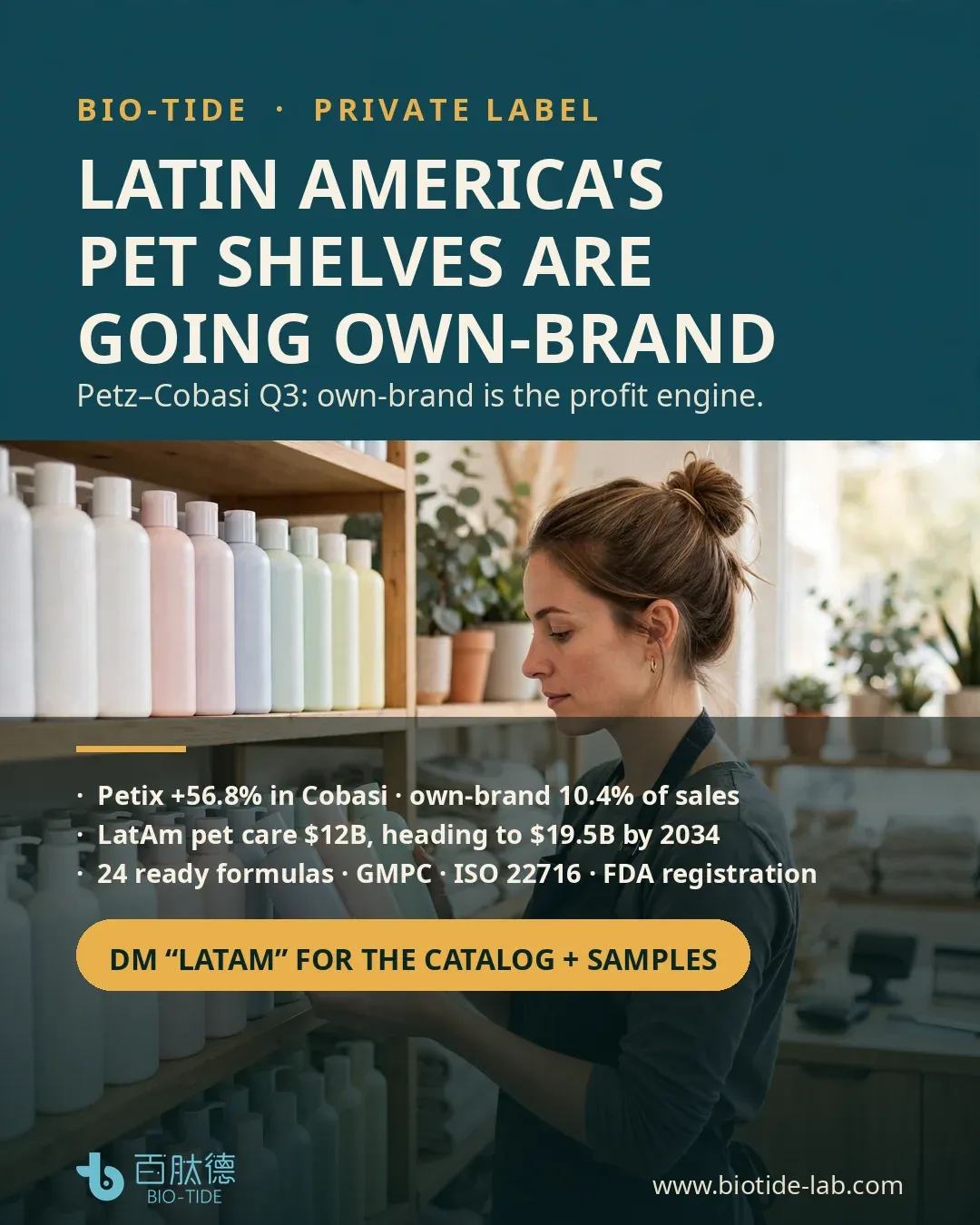
União Pet — the group formed by the merger of Petz and Cobasi — runs 519 stores across Brazil. In the third quarter of 2026, the group reported net sales of R$1.7 billion, about $310 million, up 2.2% year on year. The headline number is steady. The interesting number sits inside it: own-brand is doing the growing.
Petix, Cobasi's own brand, grew sales 56.8% year on year in the quarter and now accounts for 10.4% of Cobasi's sales. Petz's own brand accounts for 14.4% of its sales. When a retailer's own label grows at that pace while total sales grow at 2.2%, the shelf is telling you where the profit is moving.
The big manufacturers see the same market. Mars and Nestlé Purina are both expanding pet food capacity in Brazil, with new plants at Ponta Grossa and Vargeão. The region's pet care market was worth about $12 billion in 2025 and is forecast to reach about $19.5 billion by 2034, according to IMARC, a compound annual growth rate of 5.34%. More capacity, more brands, more shelf competition — and the retailers who own their label keep more of the margin.
Why own-brand is the profit engine
A retailer buys a national brand and resells it. The brand sets the price, the promotion calendar and the margin. An own-brand line flips that: the retailer sets the formula direction, the pack, the price and the promotion. The margin stays in the business instead of passing up the chain.
There is a second effect. A shopper who comes back for a retailer's own shampoo comes back to that retailer. The product becomes a reason to return to the store, not just a reason to buy a bottle. That is why own-brand share keeps climbing in the region's largest chains: it is a loyalty product as much as a margin product.
But the line only works if the product is good enough to carry the retailer's name. A shopper forgives a national brand's bad batch because the brand absorbs it. A retailer's own label has no such cover. One bad bottle is the retailer's reputation on the shelf. That is the real test — and it is a test of the manufacturer behind the label, not of the retailer's logo.
What an own-brand grooming line actually needs
It needs three things, in this order: formulas that already work, a documentation file that survives a registration check, and supply that stays the same from the first order to the fiftieth.
Formulas first. A retailer does not need a chemistry lesson; it needs a line that covers the shelf — shampoo, mousse and spray — in variants its customers already ask for. We hold 24 ready formulas across those three formats, developed as skincare-grade grooming: the same discipline on ingredients, stability and testing that a skincare line gets, applied to coats. A ready formula shortens the road from decision to shelf from months to weeks, because the work of getting the formula right is already done.
Assortment is part of the formula decision. A grooming line is not one bottle: the shelf needs a shampoo for the everyday wash, a mousse for the quick clean between baths, and a spray for the finishing touch and the home. Each format has its own job, and a customer who buys the shampoo and likes it is the customer most likely to try the mousse next. A line built from one formula family, across three formats, gives the retailer a range to sell instead of a single bottle to push.
Documentation second. Brazil's ANVISA and Mexico's COFEPRIS are both raising the evidence bar for therapeutic claims on pet products — claims about kidneys, metabolism or digestion now need peer-reviewed clinical trial data. That is a problem for sellers who promise treatment. It is an advantage for a supplier who never did. Our position is simple: we make no therapeutic claims. We provide the formula, the ingredient list, the test evidence and the manufacturing certification — GMPC and ISO 22716, with FDA registration — and the retailer's team uses that file to support its own registration. A supplier whose file is complete before you ask is a supplier who has done this before.
Supply third. An own-brand line lives or dies on repeat orders matching the first one. The same formula, the same quality, on the shelf in ten stores at once — and then again next quarter. That is a manufacturing question, not a sales promise: controlled production, batch checks, and samples before commitment so the retailer approves exactly what its customers will get.
Why the 2027 assortment is decided now
Retailers do not decide a 2027 shelf in 2027. Assortment planning, formula approval and sample sign-off happen months before the first order — and the capacity now being built in Brazil means more brands competing for the same shelf next year. A retailer that starts its own-brand line in the first quarter has time to approve formulas, test samples and lock supply before the peak season. A retailer that starts in the third quarter is choosing from whatever capacity is left.
That timing is also why a ready formula matters. A custom development program can take months from brief to approved sample. A ready formula starts from a product that already exists, already tested, already produced — the retailer's work is choosing the variants, approving the samples and confirming the pack. For a 2027 launch, that difference is the difference between on the shelf and still in development.
What to check before you choose the OEM
Ask for the file first. Before price, before volumes: the composition, the test evidence, the manufacturing certification. If a supplier cannot show those, the quote that follows is not worth much. Check the sample the way your customer will check the product — on the coat, not on paper — and approve it before any bulk is made. Confirm the minimum order in writing, and whether it is a stock formula or a custom one, because the two carry different minimums and different lead times.
Ask how the supplier handles the first repeat order, too. The first order proves the product. The second proves the supplier. A manufacturer that treats the repeat order as a new negotiation — new price, new lead time, new formula tweaks — is not a partner for a line that has to be on the shelf every quarter. The right answer is boring: same formula, same file, same checks, same price basis, on the date agreed. And agree the claim language up front: what the label may say, and what it must not say, so the registration file and the shelf copy never contradict each other.
One more check, specific to this region: confirm the payment and logistics route before you commit to a launch date. A supplier who raises that first is a supplier who has done this before.
How to start
Send us your product line and your target volumes. We will send the catalog, the samples and an itemised quote — and the documentation file your registration team needs to see. If Latin America is on your 2027 plan, the shelf is already moving. DM "LATAM" for the catalog and samples.