Pet Care
Proof Beats Promises: Efficacy Evidence in Latin America
Latin America's regulators are tightening efficacy claims. What to ask a supplier for: five evidence documents that help a grooming line survive registration.

Latin America's pet care market is growing, and its regulators are raising the bar on efficacy claims. For a buyer, the question is no longer which shampoo smells best. It is which supplier can prove what its product does — with documents, not adjectives.
What changed in Latin America — and why it matters now
Nestlé's Petcare business grew 5.3% organically in the third quarter of 2026, ahead of coffee at 3.4%. In emerging markets, its pet business has grown close to 10% organically so far this year. Pet ownership in emerging markets grew 5% a year from 2019 to 2025, against 1.9% in developed markets.
Growth brings attention, and attention brings rules. In Mexico, Brazil and Colombia, commercial pet food now covers 60% to 80% of pets' calorie needs. Mars and Nestlé Purina are both expanding wet food capacity in Brazil.
The region's pet care market is forecast to reach $18.88 billion by 2033, according to IMARC, at a compound annual growth rate of 5.79%.
A market this size attracts more brands — and more scrutiny. Brazil's ANVISA and Mexico's COFEPRIS are raising the evidence required for therapeutic and efficacy claims on pet products. A claim without published literature or trial data behind it will be harder to list. Veterinary channels are tightening their shelves too, keeping only brands that arrive with a complete evidence file.
For a retailer or distributor, that changes the buying decision. The risk is no longer only a product that sells slowly. It is a product that cannot be listed at all, or one pulled from the shelf after launch.
A launch blocked at registration costs the season — and the listing fee, the packaging and the shelf plan that went with it.
What “backed by evidence” actually means for a grooming product
An efficacy claim is a statement that a product does something specific. “Gently cleanses” is a function. “Treats a skin condition” is a therapeutic claim, and it needs clinical evidence. The line between the two is where registrations are won or lost.
Evidence, in practice, is a file, not a sentence. It starts with the formula record: what is in the product, in what order, and why each ingredient is there. It continues with the full ingredient list, written the way the registration team needs it, not the way a marketing page would shorten it.
Then come the test reports. Stability testing shows the product holds up over its shelf life. Safety testing shows it is fit for its intended use on a pet's coat and skin.
Efficacy testing, where a claim is made, shows the result that supports it. Each report answers one question, and together they answer the only question a regulator asks: can you show your work?
Manufacturing certification sits underneath all of it. GMPC and ISO 22716 describe how the product is made, checked and recorded. FDA registration records the facility. None of these is a claim about what the product does — and a supplier that confuses certification with proof is a supplier to be careful with.
The test for a buyer is simple. Ask for the file before you discuss price. If the supplier sends it without hesitation, the supplier has done this before. If the supplier sends a brochure instead, the file probably does not exist.
The five documents to ask your supplier for
First, the formula file. It should list the composition and the function of each ingredient, so your team can check it against your own standards and your market's rules. A supplier that will not share the composition cannot help you register the product.
Second, the full ingredient list, in the format your registration team uses. Labels are written for shoppers; registration files are written for reviewers. Your supplier should be able to give you both, and they should agree with each other.
Third, the test reports. Stability, safety and — where a claim is made — efficacy. Ask what each test measured, on what, and when. A report that only says “passed” without saying what was tested is not evidence. It is a summary, and summaries do not survive a registration review.
Fourth, the manufacturing certification. GMPC and ISO 22716, with FDA registration, tell your team the product was made under a controlled system. Ask for the certificates themselves, not a logo on a slide. Check the dates and the scope, and keep copies in your own file.
Fifth, the claim language itself, agreed in writing. What the label may say, and what it must not say. This is the document buyers forget — and the one that causes the most trouble. A label written by marketing and a registration file written by compliance must never contradict each other, because the regulator will read both.
Ask for all five before you approve a sample. A supplier whose file is complete before you ask is a supplier who has done this before. A supplier who assembles it after you ask is still learning your market — on your launch date.
What BIO-TIDE will — and will not — put on a label
Our position is simple, and we state it up front: we make no therapeutic claims. We do not claim to treat skin conditions, kidneys, metabolism or digestion. That is not our product, and it is not our file to write.
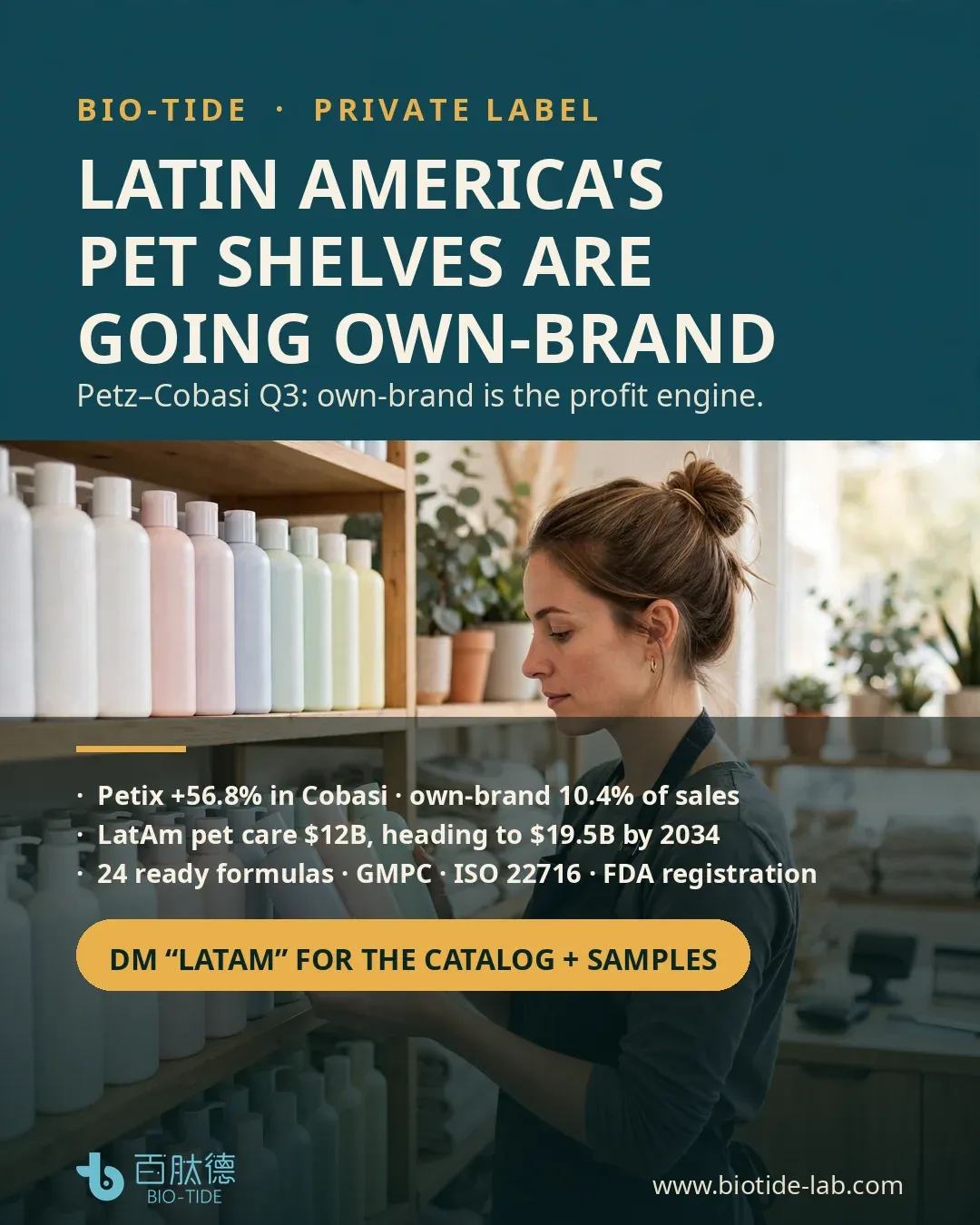
What we do is skincare-grade pet grooming: shampoo, mousse and spray, made with the same discipline on ingredients, stability and testing that a skincare line gets, applied to coats. We hold 24 ready formulas across those three formats. A ready formula shortens the road from decision to shelf, because the work of getting the formula right is already done.
With every formula we provide the file: the composition, the ingredient list, the test reports and the manufacturing certification — GMPC and ISO 22716, with FDA registration.
Your team uses that file to support its own registration, in its own words, under its own brand. We do not write your claims for you. We give you the evidence your claims stand on.
That distinction matters more now than it did a year ago. A supplier that promises treatment without trial data is selling a registration problem. A supplier that promises a formula and hands over the file is selling a launch you can defend.
There is one more thing a buyer should check, and it is not in the file. It is the repeat order. The first order proves the product. The second proves the supplier.
Ask how the supplier handles the first repeat: same formula, same file, same checks, same price basis, on the date agreed. A manufacturer that treats the repeat order as a new negotiation is not a partner for a line that has to be on the shelf every quarter.
How to start a line that survives registration
Start with the range, not the bottle. A grooming line is not one product: the shelf needs a shampoo for the everyday wash, a mousse for the quick clean between baths, and a spray for the finishing touch at home.
Each format has its own job, and a customer who buys the shampoo and likes it is the customer most likely to try the mousse next.
Choose the variants from the ready-formula library, then approve the samples the way your customer will check the product — on the coat, not on paper.
Confirm the minimum order in writing: from 1,000 units for a single stock item. And agree the claim language before the label is designed, so the registration file and the shelf copy never contradict each other.
Confirm the payment and logistics route before you commit to a launch date, too. A supplier who raises that first is a supplier who has done this before. If the route is unclear, the launch date is a guess, and a guessed date is the first thing a regulator's delay will break.
If Latin America is on your 2027 plan, the shelf is already moving. The brands that will hold it are the ones whose files are ready before the registration team asks. The question to ask any supplier, including us, is the same: show me the file.
Send us your product line and your target volumes. We will send the catalog, the samples and an itemised quote — and the documentation file your registration team needs to see, so you can check the evidence before you commit. We reply within one hour. DM “EVIDENCE” for the catalog and samples.